 St Mary's Church, Dymock
The 'Anglican Communion'
Part of the World-Wide Church
| The Anglican Communion is an international association of national 'Anglican' Churches sharing mutual agreement on essential doctrine (teaching). Each has its own 'Primate' or head known as an 'Archbishop' (Return to top) |
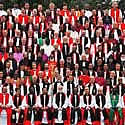 The Lambeth Conference |
The head bishop of each, known as the 'Primate', and all its other bishops come together every 10 years in the ‘Lambeth Conference’ for mutual support and discussion, which may include discussing the essential doctrines. The Conference is called and hosted by the primate of the Church of England, the Archbishop of Canterbury. The Anglican Church is the 3rd largest Christian church after the Roman Catholic and Orthodox Churches. (Return to top)
| Lambeth Conference (Advice & Support) |
The Church of England (C of E)
| The Church of England was the first 'Anglican' Church. It was created in the 16th century when king Henry VIII declared the church in England independent of Papal authority. The head of the C of E is the UK monarch. (Return to top) |
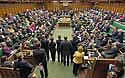 UK Parliament |
The Church of England is the official church of the land (England only) so is termed the 'Established Church'. Consequently its head is the reigning monarch and many of its rules are debated and agreed by the UK parliament and become part of English law. Major changes, such as the amalgamation of parishes and appointment to senior officers, including some priests and all bishops, have to be approved by the monarch, which is done through the 'Privy Council' a UK committee that advises the monarch on political and religious matters. (Return to top)
| Privy Council (Mainly Advice & Support) |
UK Parliament (Legislative Functions) |
Provinces of Canterbury & York
| Provinces of Canterbury and York The C of E is divided into two very large regions called a Province, each led by an Archbishop. (Return to top) |
The Archbishop of Canterbury is automatically the top bishop or 'Primate' in the Church of England. The Right Rev'd Justin Welby currently holds that post. He was installed in March 2013. Before that the head of the C of E was The Right Rev'd Rowan Williams who reached the age to retire, unlike the head of the Roman Catholic Church (known as 'The Pope') who usually stays in office until he dies. (Return to Top)
(Note: There is only one Archbishops' Council, which serves both Archbishops)
| Archbishop's Council | General Synod* |
Diocese
| The Diocese is the main body for day to day management. Each diocese is led by a ‘Diocesan Bishop’ who may be assisted by one or more 'Suffragan Bishops'. (Return to top) |
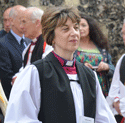 Bishop of Gloucester |
| Bishops' Council | Diocesan Synod* |
| Archdeaconry Dioceses may have one or more management and support areas under the leadership of an ‘Arch-deacon’. (Return to top) |
The Archdeacon has powers delegated by the Diocesan Bishop to provide oversight of the parishes, to ensure the parishes are adhering to the various church regulations and that they are properly maintaining their buildings, worship and care of the people in their area. The Archdeacon also acts as ‘personnel manager’ for the priests in their Archdeaconry. (Return to Top)
| Deanery A group of parishes from a geographic area grouped together under the leadership of an ‘Area Dean’. (Return to Top) |
 |
2. The Deanery provides fellowship and support for its members, offering them any assistance it's in a position to provide, especially if there should be a dispute in or between parishes and during a 'Vacancy' (ie: change of Incumbent). Ideally a Deanery should enable expertise & experience to be shared between its member parishes.
3. Through the deanery's links with, and knowledge of its member parishes, the diocese gains information to enable it to fairly share the costs of the diocesan budget. (Return to Top)
| Deanery Chapter | Deanery Synod* |
Parish / Benefice
| Parish / Benefice The lowest level of the structure is the individual parish. Traditionally this was one church with one priest (known as the 'Incumbent'). More recently, several parishes have been grouped together as a 'Benefice' under one full time (usually paid) Incumbent. (Return to Top) |
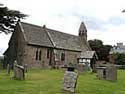 A Parish Church |
| Parish or Benefice Team | Parochial Church Council (PCC) |
Key
* 'Synod' is a Greek term and means 'Together way'
The coloured boxes mean:
The coloured boxes mean:
| Advice and Support | Legislative Functions |